Release date and availability
Everything confirmed about when Diablo: Unbound arrives, how the Gamefound campaign works, and why no price exists yet.
What this section covers
This section answers one question: can I buy Diablo: Unbound yet, and if not, when and for how much? Five pages sit under it — the Gamefound campaign, the price (or rather the absence of one), where the game will eventually be sold, whether pre-orders exist, and why the game cannot be played yet. The release date material lives on this page, because it is the head term for the whole section and splitting it across two URLs would just make both halves weaker.
One boundary up front, because it is the single most common misunderstanding: Diablo: Unbound is a physical cooperative board game from Glass Cannon Unplugged, licensed by Blizzard Entertainment. It is not a video game. There is no Steam page, no client to download, no early-access build, and no code system. Anything you read that describes a download button or a pre-order countdown is describing a different product.
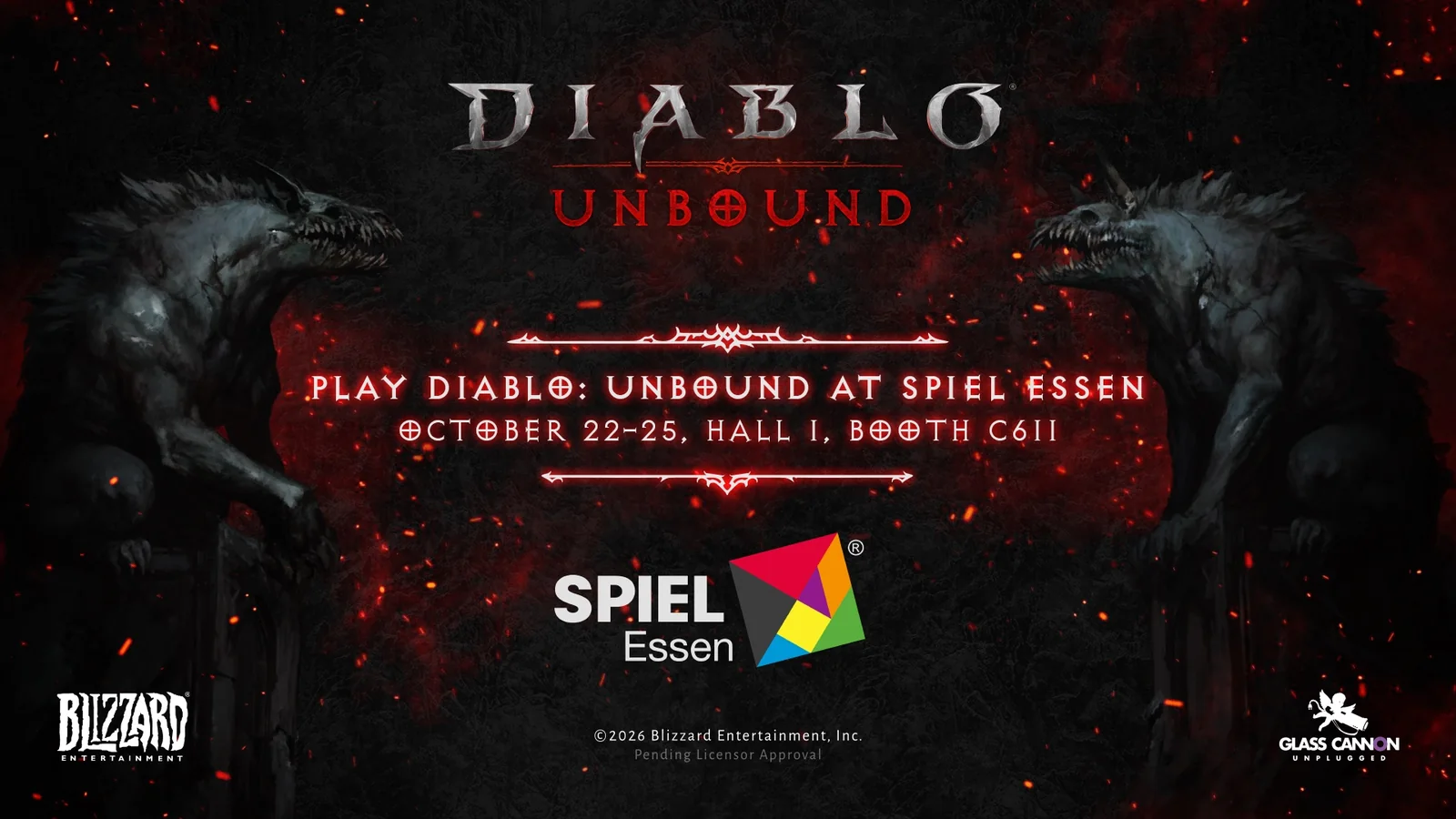
The four dated milestones that actually exist
The publisher has been precise about some dates and deliberately vague about others. Treat this table as the complete record of what is dated as of 22 October 2026.
| Date | What it is | Confidence |
|---|---|---|
| 21 October 2026 | Announced at SPIEL Essen as the first officially licensed Diablo board game | Confirmed |
| 22–25 October 2026 | Demo playable at the show, Hall 1, booth C611, four tables | Confirmed |
| Q1 2027 | Gamefound crowdfunding campaign opens | Confirmed |
| 2027 | Product release year — no month, no day | Confirmed |
That is the entire timeline. Notice what is missing: there is no shipping date, no retail date, and no date attached to the release beyond a year. When a page tells you the game "launches in Q1 2027", it has merged the campaign with the release. They are two different events roughly a year apart, and the difference matters: during the campaign you are backing a project, after release you are buying a product.
Where to start
Three readers arrive here, and they need different pages.
If you want to know whether to follow the campaign — start with the Gamefound page. It explains the prelaunch state, the two conditions attached to the free Treasure Goblin Expansion follower gift, and what "following" actually does before the campaign opens.
If you are trying to budget — go straight to the price page. The honest answer is that no price, pledge tier, shipping cost or currency figure has been announced, and that page explains why a board game can be fully designed and still have no price until the campaign goes live.
If you are looking for a shop — where to buy covers the retail question, including the one case that confuses people: the game has a publisher store page for other products, but nothing for this title yet.
If you are here because you expected a video game, read why can't I play first, then is it a board game. It settles that in one paragraph instead of making you read four pages looking for a download link.
Every page in this section
| Page | What it answers | When to read it |
|---|---|---|
| Release date and availability — this page | The four dated milestones, and which of them is the release | First, always |
| Gamefound campaign | Prelaunch status, the follower gift, what happens on day one of the campaign | Before you follow or plan to back |
| Price | Why there is no price yet, and what will change when there is one | Before you set a budget |
| Where to buy | Retail versus campaign, and how to tell a real listing from a placeholder | Before you search a shop |
| Can you pre-order? | Why there is no pre-order, and what following the campaign does instead | When you want to reserve a copy |
| Why can't I play? | The dated record of what exists, and the two reasons nothing is playable | When you expected a download |
Every page in this section is reachable in one hop from here, and each of them links back. If you ever find a page on this site about buying the game that is not in this table, it is out of date and should be treated as archived.
The order you actually need these answers in
Games sites usually present availability as a single "buy now" funnel. This one cannot, because there is nothing to buy. What exists instead is a decision order, and reading the pages out of order produces bad conclusions — mostly the conclusion that the game is imminent.
Step one: confirm what the product is. Board game, 1–4 players, cooperative, three acts of three dungeon levels. If that description does not match what you want, the rest of this section is irrelevant to you. The structure section covers the shape of the game in more detail.
Step two: separate campaign from release. The campaign is a funding event in Q1 2027. The release is "2027". Until the campaign closes, nobody — including the publisher — knows the final production schedule, because board game manufacturing is scheduled after the money is raised.
Step three: accept that price is unknown, and plan around it. This is the step people skip, and it is the one that wastes money. A crowdfunding board game with miniatures typically lands in a wide band depending on component count, and component count is exactly what has not been announced.
Step four: decide whether the follower gift is worth the two minutes. Following the prelaunch page costs nothing and is one of the two conditions for the exclusive Treasure Goblin Expansion. The Gamefound page lists both conditions, because missing the second one is the common failure.
What is still unknown about availability
Listing the gaps is more useful than inventing a reassuring answer, so here is the list as of 22 October 2026. Everything below is Unknown, meaning no publisher statement exists — not "we could not find it", but "it has not been said".
- The price, in any currency.
- Pledge tiers, and what each tier contains.
- Shipping cost, and which countries can be shipped to.
- VAT and import handling for buyers outside the EU and US.
- Whether there will be a retail edition distinct from the campaign edition.
- Languages of the printed rulebook and cards.
- Box size and weight, which is what actually drives shipping cost.
Every one of those will be answered during or shortly before the campaign. Until then, any number you see quoted on a fan site, a forum or a video thumbnail is an estimate, and the further it is from "we do not know", the less reliable it is.
Three mistakes we see most
Quoting a price that does not exist. A figure circulates in comment threads as soon as a board game is announced, usually derived from the publisher's previous Kickstarter. Diablo: Unbound has more miniatures than those projects, so the comparison does not hold. If you need to budget, budget a range and treat the low end as unlikely.
Reading Q1 2027 as a release date. It is the campaign window. A campaign that opens in Q1 2027 with a 2027 release year implies a very compressed production schedule, which is itself a reason to expect the release window to move.
Assuming a shop listing means availability. Placeholder product pages appear on retailer sites before campaigns, sometimes generated automatically from a publisher catalogue. A listing with no price and no date is not a pre-order; it is a stub. The where to buy page explains how to tell them apart.
If you have read this far, the practical summary is short: nothing is purchasable today, one free action exists (follow the prelaunch page), the campaign opens in Q1 2027, and the release year is 2027 with no date attached. Everything else in this section is detail on those four sentences — starting with how the campaign works.
Where to go next
Availability is only half of a purchase decision; the other half is whether the game is the kind of thing you play. If you are past the "can I buy it" stage, these are the pages that answer the rest:
- Acts, levels and playtime — how long a campaign runs, and whether your group's schedule survives it
- How long does it take — the per-session numbers, with the arithmetic shown
- How to play — the seven-step loop, from choosing a class to Torment
- Solo — the single most important page if you play alone
- Classes — four launch classes and the honest limits of comparing them
- Loot and treasure — five confirmed sources, zero published drop rates
- Is it a board game? — one page, in case you landed here expecting a download
- The other Diablo games — the full list of products this name collides with
Read in that order and you will have spent about twenty minutes to know everything that is currently knowable. Anything not covered by those eight pages has not been announced yet, which is why the section above lists the gaps instead of filling them.
Can You Pre-Order Diablo: Unbound? No — Here Is What You Can Do Instead
Diablo: Unbound cannot be pre-ordered: no shop listing, no wishlist, no deposit. The only early action is following the Gamefound prelaunch page.
Read moreDiablo Unbound Gamefound Campaign Schedule and Availability Facts
Check Diablo Unbound Gamefound availability: Glass Cannon Unplugged confirms a Q1 2027 crowdfunding campaign and 2027 release window for the board game.
Read moreDiablo Unbound Price and Crowdfunding Schedule for Glass Cannon Unplugged
Check the Diablo Unbound price and availability: no price, pledge tier or shipping cost has been announced yet. The Gamefound campaign opens in Q1 2027.
Read moreDiablo Unbound Where to Buy: Gamefound Campaign and Release Timeline
Find out where to buy Diablo Unbound. Learn about the upcoming Gamefound crowdfunding campaign, the 2027 release date, and prelaunch details.
Read moreWhy Can't I Play Diablo: Unbound? Out Yet, Explained (October 2026)
Diablo: Unbound is a board game that has not been released. It is due in 2027, with a Gamefound campaign in Q1 2027. Here is what exists now and what does not.
Read more